


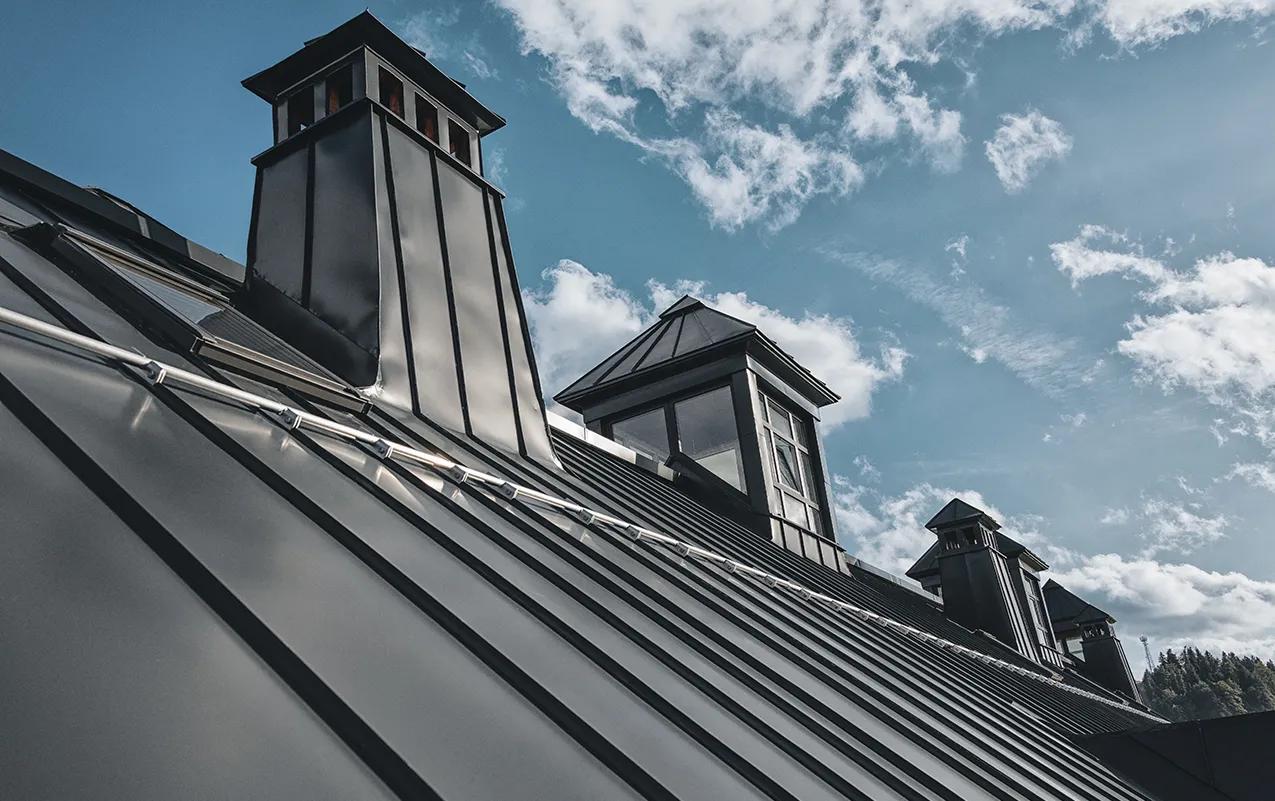
Are you considering a metal roof or cannot decide for the right type of roof covering? We will advise you on how to make the right decision and what advantages or disadvantages sheet metal roofing can bring you.
A house without a roof is like a tree without a crown. It stands unprotected and is exposed to all weather influences. This is also why the roof is one of the most important parts of every building. If the structure is of poor quality or the roof covering is chosen incorrectly, leaks and damage to the house can easily occur.
How to choose a roof covering
Choosing the right roof covering depends on several factors, which influence the functionality, service life and aesthetics of the roof. Here are the key aspects to consider:
1. Roof slope
First of all, it is necessary to choose a roof covering according to the slope of the roof. The recommendations are as follows:
- Flat roof (up to 10°): PVC foils, asphalt bands, sheet metal roofing.
- Slightly sloped roof (10 – 25°): sheet metal roofing, asphalt roofing tile.
- Steep sloped roof (above 25°): ceramic or concrete tiles, or wood shingles.
2. Material and weight of roof coverings
The roof coverings can be distinguished by weight. The weight of the material affects the load on the roof structure (truss) and thus also the stability and service life of the roof.
- Lightweight roof coverings (sheet metal, asphalt shingles) – are suitable for reconstructions and older roof trusses that do not have sufficient stability.
- Heavy roof coverings (ceramic, concrete tiles) – require a stronger truss to support their heavy weight.
3. Resistance to weather conditions
The type of roofing must also be chosen according to the climatic conditions in which you live. You need different roofing material if you live in a windy area or in mountainous conditions.
- Strong wind – heavy tiles or firmly anchored sheet metal roof coverings are more suitable.
- Snow load – concrete or ceramic tiles are sufficiently resistant to load.
- Rain and humidity – asphalt bands or well-sealed sheet metal coverings are suitable, while high-quality waterproofing is required.
4. Service life and maintenance
Each type of roofing material has its expected service life, which is usually reflected in the price.
- Ceramic and concrete tile – service life 50+ years, minimum maintenance.
- Sheet metal covering – service life 30 – 50 years, but additional corrosion protection may be required.
- Asphalt shingle – service life 20 – 30 years, but is more susceptible to damage, such as in heavy storms.
5. Price and budget
The service life almost proportionally affects the price of the roof covering, which is reflected in the total cost of the roof.
- The cheapest solution – asphalt shingle clearly.
- Medium price category – practical roof metal covering.
- The most expensive solution – traditional ceramic and concrete tiles.
6. Aesthetics and style of the house
Of course, the choice of roof covering is also subject to aesthetics and should underline the overall architectural style of the house.
- Traditional houses – ceramic or concrete tiles, which will guarantee a classic look, are suitable.
- Modern houses – modern sheet metal roofing is often chosen, it underlines the minimalist style of the house.
- Country houses – wood shingles or straw roofing are suitable for building country houses or cottages.
Advantages and disadvantages of sheet metal roofing
Sheet metal roof is an increasingly popular choice due to its many strengths, such as durability, quick installation and affordable price. It fits well with current modern architecture, which is dominated by clean lines, geometric shapes, flat roofs and minimalist style.
Types of sheet metal roofing
- Lamella (corrugated) roofing: it consists of simple sheet metal panels with a corrugated profile. It is a practical type of roofing, which is mainly used for agricultural buildings, warehouses, or industrial facilities where aesthetics are not the priority. It is the cheapest solution.
- Trapezoidal roofing: it has a trapezoidal profile with different heights and is used for family houses and commercial buildings. It provides a simple technical look. It is the most common type of sheet metal roof for modern buildings. This is a more resistant and expensive solution compared to corrugated sheet metal.
- Folded roofing: it is a type of metal roofing in which individual metal bands are joined using special double or single folds (bends). This method of joining ensures high resistance to water and wind. However, it is more difficult to install.
- Roof covering click system: this roofing is installed using a simple click mechanism. Individual pieces of roofing click into each other CLICK. It enables quick and easy installation.
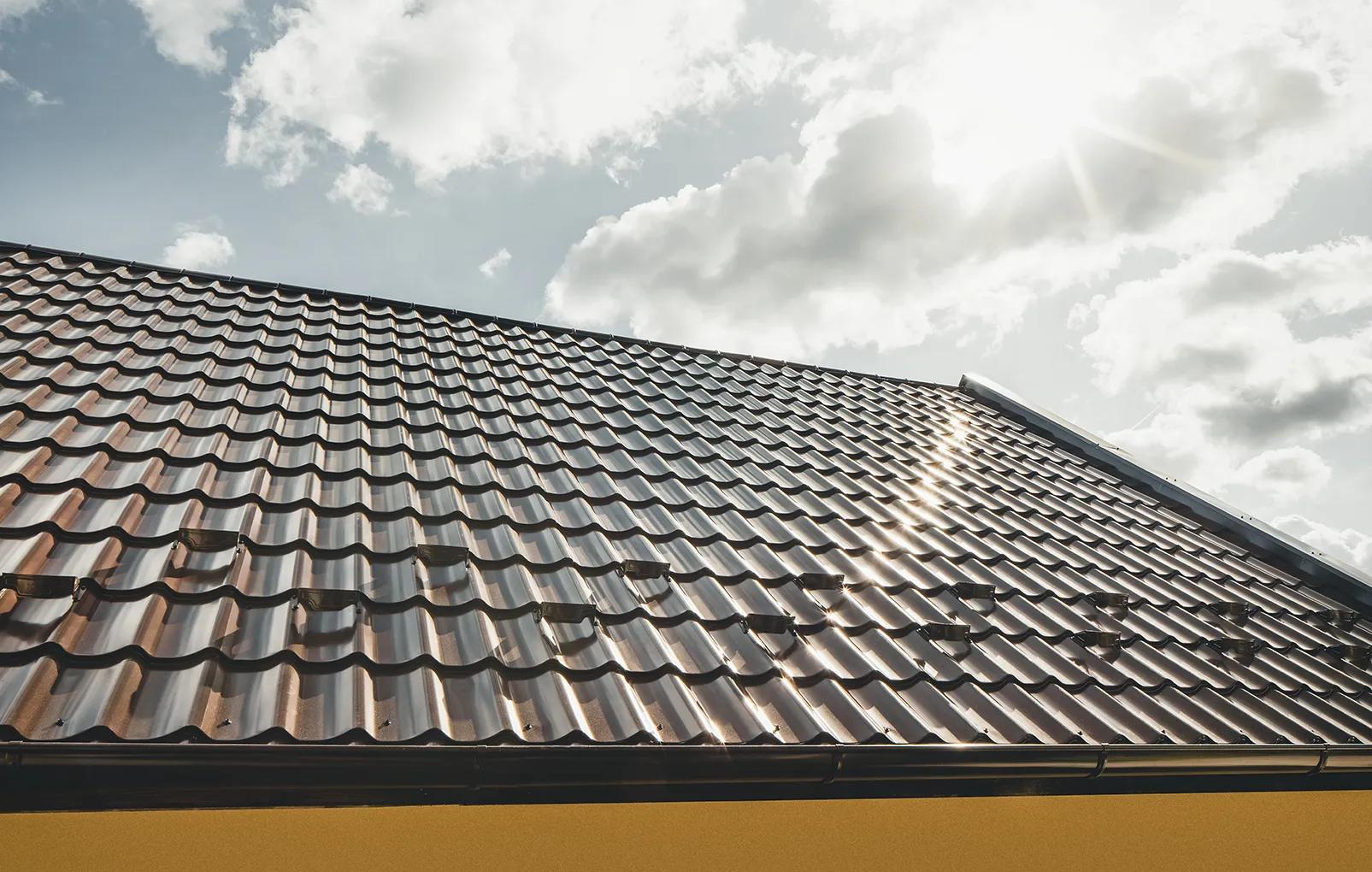
- Rhomboid roof tile: it consists of smaller regularly arranged templates that can have different shapes. They are laid on the roof with an overlap to ensure full protection against weather influences. The templates resemble shingles and give the roof an aesthetic look.
Material od sheet metal roofing
Sheet metal roofing is made of various materials which differ in durability, resistance, look and price. Thus, the choice depends on your personal preferences, desired look and budget. The most common materials are:
- Galvanized steel: it is affordable and corrosion-resistant thanks to zinc.
- Aluminium: very light metal, highly resistant to corrosion, more expensive than steel.
- Titanium zinc: a more expensive material, but provides longer service life and resistance.
- Copper: provides luxurious look and long service life at a high price.
As a general rule, sheet metal roofing made of non-ferrous metals (aluminum, titanium-zinc, copper) is more expensive. Roof coverings are available in various surface finishes that increase their resistance and service life, as well as in different colour versions. Thus, it is not a problem to match the colour of the roof with the colour of the facade, windows or with the overall design of the house.
Advantages of sheet metal roofing
A range of practical advantages make sheet metal roofing a great choice for various types of buildings:
1. Low weight
Compared to traditional materials (ceramics, concrete), sheet metal roofing is very light. It does not burden the roof structure so much, extend the roof´s service life and facilitates installation. It is also suitable for buildings with a less resistant structure.
2. Low price
As well as the weight, the price is also low. The cost of a sheet metal roofing can be half that of ceramic roofing. You will achieve further savings with cheap installation and subsequent maintenance.
3. High resistance
Metal roofing is sufficiently resistant to rain, snow, wind and other weather influences. Thanks to the smooth surface finish, the risk of leakage is reduced. Thanks to surface finishing, they are resistant to corrosion and are non-flammable, which reduces the risk of fire.
4. Quick installation
Installation of sheet metal roofing is very simple, fast and efficient. Sheet metal panels are usually ready directly for installation, which reduces the time required to complete the construction. It will also save you labour costs.
5. Environmental friendliness
Sheet metal roofing is often made of recyclable materials and can be reprocessed after the roof's service life has ended.
6. Versatility
This roofing is suitable for almost all types of roofs, including flat and pitched roofs or more complex shapes. They are suitable for residential and industrial buildings. Thanks to the wide range of surface finishes and colour variants, they can be adapted to any design.
Disadvantages of sheet metal roofing
In addition to the range of advantages, it is also necessary to mention some disadvantages or risks of sheet metal covering. The greatest ones include:
1. Noise
In rain, hailstorm or strong winds, the sheet metal roofing can be noisy. However, modern roofing materials does not have this problem, because they are equipped with insulating layers that dampen noise.
2. Condensation
Sheet metal reacts quickly to temperature changes, which can lead to the formation of condensate on the underside of the roofing if it is not well ventilated. However, this can be solved by an anti-condensation coating or layer.
3. Expansion and contraction
When temperatures change, metal expands and contracts, which can cause joints to creak or loosen if expansion gaps are not properly designed.
4. Susceptibility to damage
Sheet metal can be dented during severe hailstorm or handling. Although modern sheet metal roofing is protected by surface finish, damage to this layer can lead to rusting.
5. Aesthetic aspects
Some people simply do not like the look of a sheet metal roof compared to traditional materials such as tiles. For some buildings in a classic style, it will not be aesthetically compliant.
6. Poor thermal insulation
Sheet metal is quickly heated and cooled, which can affect the thermal comfort in your garret if it is not properly insulated. This can increase your heating or air conditioning costs.
If you decide for a sheet metal roof, it is important to invest in high-quality roofing, insulation and proper installation in order to minimize these disadvantages as much as possible. You can find everything you need for an honest roof at kjg.sk/en.